Wedding Invitation Wording: Examples to Make Your Own
Adapt formal, relaxed, couple-hosted and family-hosted wedding invitation wording, with clear guest details and practical RSVP lines.
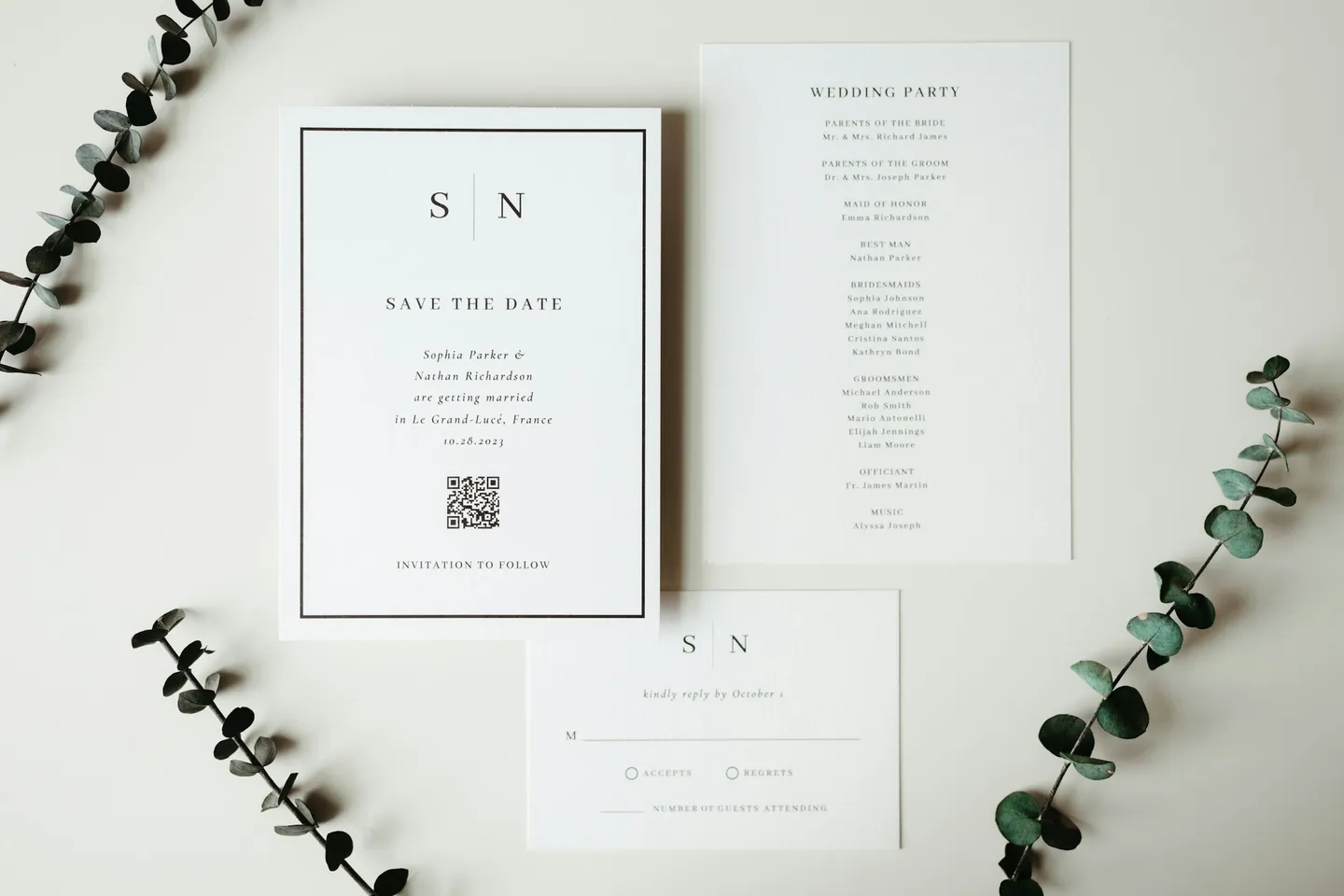
Wedding invitation wording can be warm, formal or wonderfully simple. Start with who is inviting your guests, what they are invited to, and where and when to arrive. Then add the details that help them respond. You do not need to adopt a hosting formula that feels wrong for your family.
The examples below use fictional names, venues and dates. Replace every detail, including the RSVP deadline, before sending.
The essential details to include
Make the invitation easy to act on by including:
- The names you and your partner want guests to recognise.
- A clear invitation to the wedding ceremony, reception or both.
- The date, including the year.
- The arrival or start time, labelled clearly.
- The venue name and a usable address.
- How to RSVP and the date you need a reply.
If the ceremony and reception are in different places, give each its own location and time. If you ask guests to arrive before the ceremony, distinguish those times: “Please arrive at 2:30 pm for a 3 pm ceremony.” Choose a deadline that leaves you enough time to follow up before your own supplier deadlines.
Formal wedding invitation wording
A formal tone can come from a few deliberate phrases and a spacious layout. You can still use the names and titles that suit you.
Together with their families,
Alex Morgan and Jamie Ellis
request the pleasure of your company
at their wedding
on Saturday, 12 June 2027
at 3 pm
Willow House, 18 Garden Lane, Bristol
Dinner and dancing to follow at the same venue.
Please RSVP through this invitation by 1 May 2027.
This version acknowledges family without naming particular hosts. Remove the first line if you prefer the invitation to come directly from the two of you. “At the celebration of their marriage” is another option if it describes your event more accurately.
Relaxed wedding invitation wording
For a conversational invitation, write as you would speak to someone you are excited to see. Keep the practical details just as precise.
We're getting married!
Alex and Jamie
would love you to join us
on Saturday, 12 June 2027.
Please arrive at 2:30 pm for our 3 pm ceremony
at Willow House, 18 Garden Lane, Bristol.
Stay for dinner and dancing afterwards.
Let us know through this invitation by 1 May 2027 whether you can make it.
You can replace the opening with “Come celebrate with us” or “Join us for our wedding.” A playful opening works best when it does not make guests hunt for the date or place.
Couple-hosted wedding invitation wording
You can invite guests in your own names without explaining who is paying. First-person wording keeps the invitation personal and avoids a separate hosting line.
We, Alex Morgan and Jamie Ellis,
invite you to celebrate our wedding
on Saturday, 12 June 2027
at 3 pm
at Willow House, 18 Garden Lane, Bristol.
A reception will follow at the same venue.
Please reply through this invitation by 1 May 2027.
Use full names, familiar names or a combination that your guests will understand. There is no need to label either partner as a bride or groom unless you want to.
Family-hosted wedding invitation wording
If particular family members are issuing the invitation, name them in a way everyone involved is comfortable with. Agree on that line before you design the final version.
Robin Morgan and Casey Morgan
and Taylor Ellis
invite you to celebrate the wedding of
Alex Morgan and Jamie Ellis
on Saturday, 12 June 2027
at 3 pm
at Willow House, 18 Garden Lane, Bristol.
Dinner and dancing to follow.
Please RSVP through this invitation by 1 May 2027.
Adapt the names and grouping to your family. You can include parents, stepparents or other loved ones without describing their relationships on the invitation. If a list feels cumbersome or uncomfortable, “With their families” is a simpler alternative. A remembrance line is a personal choice; discuss the wording with those closest to the person before including it.
Make the guest list clear in the wording
Named guests and plus-ones
Use the message accompanying your invitation to make clear who is invited. For example: “Alex Chen and Sam Patel, we'd love you both to join us.” If you are offering an unnamed plus-one, you might write: “Alex Chen and a guest.”
Avoid “and family” when you mean a specific set of people. Naming the invited guests can prevent uncertainty about children or additional partners. Check that the RSVP instructions match what you have offered.
Adults-only celebrations
If children are not invited, state the arrangement kindly and directly. For example: “Our ceremony and reception will be for adults only. Thank you for making arrangements ahead of time.” If there are exceptions, a private message to the affected guests can explain their invitation more clearly than a complicated general statement.
Reception-only invitations
Say exactly which part of the celebration guests are joining. For example: “Alex and Jamie invite you to celebrate their marriage with dinner and dancing on Saturday, 12 June 2027, from 7 pm at Willow House, 18 Garden Lane, Bristol.” Avoid including a ceremony arrival time on a reception-only invitation.
Add practical information without crowding the invitation
Keep the main wording focused on the invitation itself. Put longer travel, parking or access information in a separate details message when needed. If you include a dress code, use a label your guests can act on and explain any unusual requirement: “The ceremony is outdoors on grass; please choose suitable shoes.”
For guests across the US, UK, Canada and Australia, spelling out the month can remove ambiguity from numeric dates. Use a consistent time format and add a time zone if guests need to coordinate across locations, such as for a remote celebration.
Belowen offers digital invitations with RSVP. A simple line such as “Please RSVP through this invitation by 1 May 2027” can connect your wording to the response step. For more help planning that request, see our guide to collecting wedding RSVPs online.
Proofread the invitation as a guest
Before sending, ask someone who has not been involved in planning to read it. Can they tell who is invited, which event they are attending, when to arrive and how to reply?
Check each name, the weekday against the date, the full address, the ceremony and reception times, and the RSVP deadline. Replace all sample details and test the response process. Read the invitation on a phone so you can see whether the important information is easy to find.
Wedding invitation wording questions
Do we need to name our parents?
Choose the attribution that reflects the invitation you want to send. You might name family hosts, use “Together with their families,” or begin with your own names. If family recognition matters to several people, agree on the wording together before sending.
Can we use the same wording for every guest?
You can reuse the central invitation text, but check the guest names and event access each time. A reception-only guest needs different event details from someone attending the ceremony, and a named invitation should not accidentally imply an open plus-one.
How long should the invitation be?
Use enough space to make the invitation and next step clear. If a detail helps guests know where to go, when to arrive or how to respond, keep it easy to find. Move longer explanations into accompanying information rather than shrinking everything to fit.
Choose a design that suits your words
Once your wording is settled, choose a design that gives the names, date and response instructions room to breathe. Explore Belowen wedding invitation templates for a digital invitation with RSVP, then check your final text in the design before sharing.
Photo: Micah & Sammie Chaffin on Unsplash. Used under the Unsplash License. Illustrative stationery; not a Belowen template.